Badwater 2009 Race Report – Part 2
After the start, we jumped into the van and drove down the road about 1.5 miles to meet Blake for his first “aid station.” (Badwater is an “unsupported” race – there are no official aid stations along the course. There are six timing stations along the way where racers have to check in with the officials. There are also a few medical stations along the route. But anything the participants needs during the race is supplied by his/her crew.) Our plan was that, for the first “part” of the race, we would meet Blake every 1.5 miles or so in order to swap out water and nutrition bottles, spray and/or sponge him down with cold water, trade out his icy bandana and get him anything else he might need.
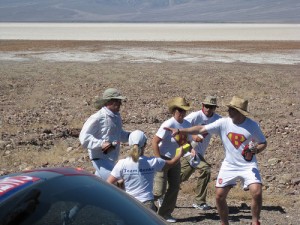
At the beginning of the race, time was definitely of the essence at our crew stops. Blake was moving pretty quick and our goal was to make sure that he didn’t have to stop or even slow down. Other than Diane and Caroline, none of us had done anything like this before, but we got a handle on it pretty quickly! You can see it all in the below picture, Caroline’s got the bandana, Rickey’s trading a bottle of Nuun, Carlo with the spray bottle and Diane with a sponge.
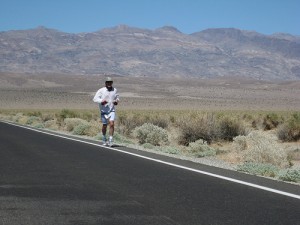
At the beginning of the race there was a six man pack out leading the way. The pack was Marcos Farinazzo (eventual winner), Oswaldo Lopez (2nd), Zach Gingrich (3rd), Jorge Pacheco (6th) and Blake. They were really moving! Blake fell off the back after about 10 miles (I think), but to give you a sense of how fast they were moving, the pack got to the first check-point (Furnace Creek, 17.4 miles) in 2:11! That’s about a 7:30 pace. Just in case that doesn’t sound fast enough (and it definitely is), keep in mind that it was already over 110 degrees!
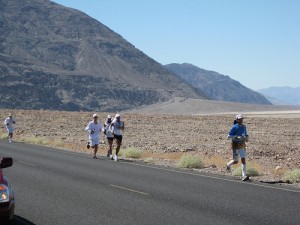
The racers are not allowed to have pacers running with them until they pass Furnace Creek (mile 17.4). Blake told us that he would probably want a pacer beginning somewhere between miles 25 and 30. The pacer’s job would be a busy one – help Blake keep relatively on pace, carry his water/nutrition bottles, carry a spray bottle to keep him wet, talk to him to keep him a little distracted, watch him to make sure he’s doing OK, let the rest of the crew know what he would need at the next stop and generally keep him company on the long, hot, lonely road. Our biggest struggle at this point was keeping Blake “wet” in the ultra-dry environment. We were constantly spraying him down, but the moisture evaporated within minutes of hitting his skin.
Compared to many of the other crews (especially those of the expected race leaders), we were something of a ragtag crew. Despite our dedication and our interest in the race and participation in endurance sports, none of us had the type of ultra-endurance racing cred that surrounded us. Other racers had crews made up of Badwater veterans, ultramarathon champions, national ultramarathon team members seasoned crew, coaches, physical or massage therapists, or people who were all of the above. We took a page out of Blake’s book and laid low, flying under the radar, hoping to surprise everyone with a fast finish.
At about mile 23, I jumped in to be his first pacer. I thought that, after my short run on Sunday and some time getting acclimated to the heat and the fact that he was running at a pace I could normally sustain, I would be able to stay out there a while. I quickly realized that that was some crazy thinking! It was hotter than I’d imagined and between trying to keep up with Blake and handle my crew/pacer duties, I was spent after less than 40 minutes. Also, the last thing I wanted to do was blow it out early on Day 1 and be useless (or worse, a liability) later in the race. I traded out with Rickey, jumped in the van to cool down and give Caroline and Diane a little report and watched them take off down the road. (Each time I ran or walked with Blake I started a new file on my watch. I’m glad I did it because it gave me a great sense of how much time I was actually on the course.)
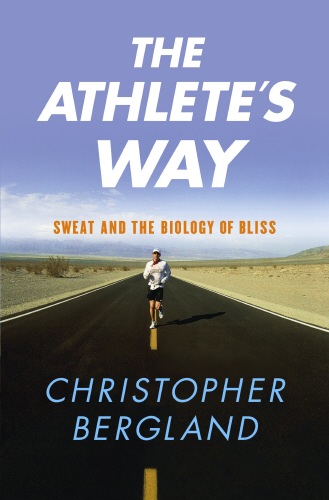
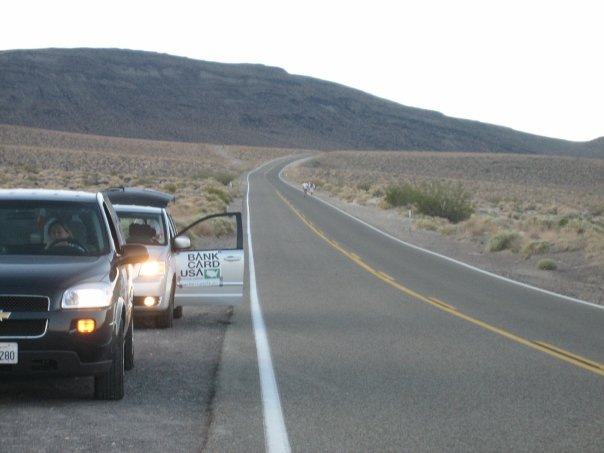
Somewhere around mile 25, the course takes a turn to the left and you start on this long, mostly straight, mostly flat road that stretches all the way until about Stovepipe Wells (the second timing stop) at mile 41.9. This is the road that some of the most symbolic pictures of Badwater come from. I’m pretty sure that the cover photo from Chris Bergland’s book, “The Athlete’s Way” (reviewed in part by me here in March 2007) was taken at this part of the race. (It might have been taken on the long road heading to Lone Pine – see below – those two long, lonely stretches look pretty similar!)
And here’s my shot (which I’m guessing is somewhere in the low-30’s):
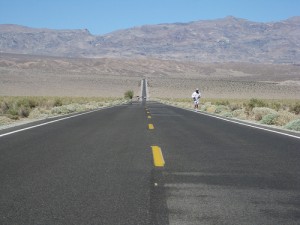
At this point, the temperatures (on the car thermometer at least) are around 122 or 123 degrees. And Blake’s been out there in that heat for over five hours! He’s still moving great; slowing down or briefly stopping at each crew/aid stop, but still looking and running great. The van is now stopping more like every mile. It’s just too damn hot to leave him out there for more than a mile at a time. The fluid in the handheld bottles heats up really quickly. Also, the frequent stops enable us to check on the pacer more regularly! He’s still solidly in 5th place. We knew that he hadn’t been passed by any other 10am wave starters and we didn’t think there was anyone else from an earlier wave moving into the top five.
At some point in this area, we changed Blake’s shoes and socks. His feet were hurting him a little and we could tell that his socks were getting a little wet, which could spell absolute disaster. When we got his socks off, his feet were already a little messy – some blisters between his toes and on the inside of one foot and some substantial blood blisters on his toes. As I was trying to fit his left foot into the Injinji sock, one of the blood blisters popped and the top of his sock was filled with blood. I must have blanched and definitely paused but Blake just told me to keep going and get the sock on. The condition of his feet this “early” in the race was definitely not a good sign.
The car stopped for ice and water in Stovepipe Wells. There are only a few places along the course where you can buy ice, water, food or other supplies. They roughly correspond with the six timing stations. After Stovepipe, the first of three major climbs along the course begins. This 17 mile climb goes from Stovepipe Wells (sea level) to Towne’s Pass (4,956 feet). Pretty much all we wanted at this point was a little shade. As we climbed, the temperature dropped, and near the top of Towne’s Pass, it was only in the 90’s! Blake was still hammering along, running and walking. Our crew stops were a little slower now, but no less urgent. Even if Blake was just walking by the van or even stopping to sit for a minute, we wanted him to have everything he needed/wanted immediately when he got to us. Our basic system was that as Blake and the pacer would approach the van, the pacer would either sprint ahead or shout to the rest of the rest of the crew short one word commands: “Perpetuem, Nuun, sponge, bandana!” Or “CHAIR”, which meant the camping chair would be pulled out and positioned in a little shade for Blake to rest for a couple seconds. And the rest of the crew would have it all waiting by the time Blake got there.
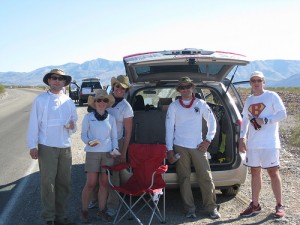
Every so often beginning in this part of the course, Blake would sit in the chair for a quick rest. At first, I was concerned that after sitting he would struggle to get back up. But Blake’s a warrior and he never sat still for very long. After sitting for a minute or so, something would light up in his eyes (often it was a thought that someone was catching up from behind!) and he would take off, never giving much warning or waiting for the pacer to be ready. This was a tough part of the race, it was still really hot, his feet were already aching and he was having a hard time keeping down fluids. He’d already thrown up once – mostly a couple liters of liquid. He had been complaining about sloshing in his stomach and was relieved and felt better after he threw up, but we knew that the vomiting meant that he wasn’t absorbing a lot of what he was taking in. We were racking our brains trying to figure out what he needed – more electrolytes, less electrolytes, solid food, liquid calories, more water, less water… Trying to figure out a cure for this came to be one of the most difficult parts of crewing. We tried everything we had, but either it didn’t work or we just couldn’t tell. Under the circumstances, I wasn’t surprised that his body was having trouble accepting fluids or fuel, but that didn’t make it any less frustrating!
It was during this climb that a few other racers from Blake’s wave finally caught up to him. He was passed here by Pam Reed (7th place) and Jamie Donaldson (5th place). Charlie Engle (4th) passed somewhere around Panamint as well.
After the summit at Towne’s Pass, you start a 12 mile steady descent towards the third timing checkpoint at Panamint Springs. Blake started the descent at about the same time that it was getting really dark. The absence of the blazing hot sun and the resulting drop in temperature re-energized Blake (it actually dropped into the high-60’s for a short couple of hours in the middle of the night) . After trudging up the climb, Blake was able to get back into his element and run. And run he did! He flew down the descent, averaging about a 7:30/mile pace and barely stopping for the van. Most of us got a piece of this fun running action. This was one of my favorite parts of the race. It was my first true night running experience and I loved everything about it. Except the moon, stars and the little beam from our headlamps, it was pitch black out. For big sections of this descent we were running completely by ourselves and it was deadly quiet. And I loved that we were running again. The few other racers/crews that we did pass were shocked by how quickly we were going this far in into the race. Blake made up a lot of time here and re-passed Pam Reed.
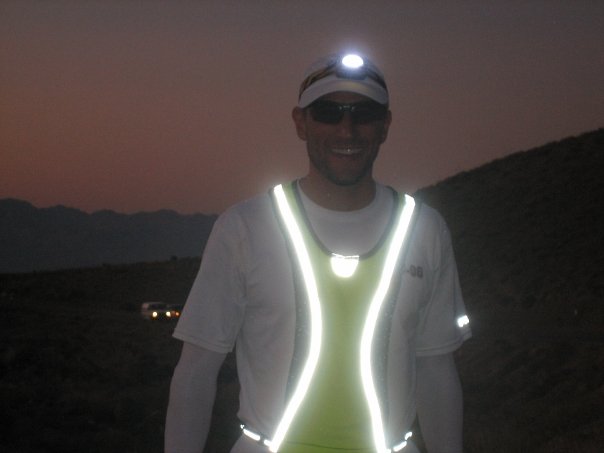
During the night, we rotated turns getting a little bit of shut-eye. We sent two people at a time in the car forward a few miles, where they could close their eyes and wait for Blake and the van to catch up. It worked really well. Craig and I drove ahead at one point and we both slept pretty soundly for 45 minutes. Even though it doesn’t seem like much, that 45 minute nap was one of the keys to my ability to keep going through Tuesday afternoon.
The long descent ends around mile 60 when you get to Panamint Springs and then immediately start another long climb. And by “long”, I mean 21 switchbacking miles with at least 3,500 feet of climbing. Thankfully, we were doing this climb in the darkness and relative coolness of night. Blake was mostly walking up these hills, but he took advantage of any flat section and really let his feet move. We were leapfrogging with Jamie Donaldson’s crew, who was only about a mile behind us. I had a good time interacting with her crew during this stage of the race. For the first 70 or 80 miles things between racers and crews seemed much more serious and less friendly. I guess that as the race and night grew longer, and upon acceptance that we would be seeing each other a lot for the next long section of the race, things got warmer and friendlier.
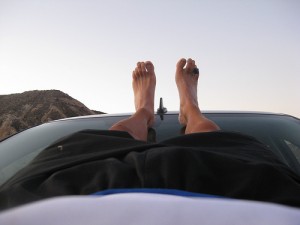
Towards the end of that climb, dawn was approaching and I got my second rest period. Rickey and I drove ahead a few miles. This time I was a little too amped to sleep. During the night I’d spent a lot of time on the course with Blake; over two hours of running the descent and run/walking the climb. My legs were tired and I knew I’d be needing them on Tuesday for the last parts of the race. So I laid down on the hood of the car, put my feet up (on the windshield) and half closed my eyes and half watched the sunrise.
A little after dawn, Blake started on a seemingly endless 30 mile section of the course going from mile 90 until the Dow Villa Hotel in Lone Pine. This is really hard part of the course. It’s daylight again, so it’s hot and sunny. Blake had been on the course for 24 hours, so he’s exhausted, dehydrated and all other kinds of f’d up and, to make matters worse, if you look straight across the desert you can see Lone Pine, but the winding, mostly flat road between stretches for 30 miles that feel like forever. We weren’t about to take his shoes off, but we knew Blake’s feet were a mess. Running caused him a lot of pain. From this point forward, the race was mostly a walk with some brief periods of running mixed in.
During this stretch we found out that last year’s champion, Jorge Pacheco, was only a half mile or so ahead of us. That energized Blake to do some running and fast walking and soon we caught up to and passed Pacheco. He was really friendly, and he and Blake had a nice little exchange (and I spoke with his pacer) as we walked past him. Pacheco was walking slowly and casually, and we figured something must have happened to cause him to fall so far back from the lead. Blake passed the 100 mile mark in about 20 hours, which is an outstanding time for a stand-alone 100 that doesn’t involve the heat and hills of Badwater (and Blake thought it was a PR). This section of the race became a major struggle, both for Blake to keep moving forward and for us on the crew to deal with everything happening all over and inside his body.
Around mile 115, Blake got passed by two more runners. No one was moving all that quickly, but Pam Reed and Phillip McCarthy were just running a bit more than Blake at this point. At this point, he was in 8th place. At mile 120, you finally get off that endless Highway 136 and turn towards Lone Pine. For the first time in the race, it feels like you’re in “civilization.” It’s a four lane road with lots of traffic, billboards advertising fast food and even some motels.
The fifth timing checkpoint is at the Dow Villa Hotel at mile 122. It’s also the headquarters for the race finish. Just past the Dow Villa you turn onto the Whitney Portal Road and begin the final climb up to the finish. Only one crew vehicle is allowed to go up to the Portal, so we parked the car, all packed into the van and started following Blake up to the end.
When he started up the Portal Road, Blake had been on the road for 122 miles and 22.5 hours. He was mostly walking. And it was at this point, with 13 miles to go that the hardest part of the race really began…
(special thanks to Diane Benke for a couple of the photos!)
(edited a few times to re-size photos)
dang Bro.. its so amazing to read stories of BW and all of our experiences!
You can check out Mollys blog for her recap http://mollysheridan.blogspot.com
rockon`